
Most managers genuinely want to build strong teams and healthy workplace cultures. They care about trust, engagement, and helping people do their best work.
However, despite these good intentions, many managers unknowingly adopt small, everyday habits that sabotage workplace culture. These habits may not appear harmful on the surface. They show up in how decisions are communicated, how work is delegated, and how feedback is given or not given at all.
One manager shares outcomes without explaining the reasoning. Another checks in too often, thinking it’s support. Someone else avoids a tough conversation, hoping the issue resolves itself. Individually, these actions seem harmless. Over time, they erode trust, limit ownership, and drain motivation from the team.
The good news is that these habits aren’t fixed traits or leadership flaws. They’re behaviors and behaviors can be changed. This article breaks down nine silent habits managers often overlook, explains how each one impacts team culture, and offers practical ways to correct them before they do lasting damage.
9 silent habits that sabotage workplace culture and how to improve them
Managers build a culture where creativity thrives, teams feel comfortable, and move together towards the path of success. However, some culture-damaging habits can become an obstruction to it.
The following are some of those habits that must be identified and worked upon to make a thriving workplace culture for everyone-
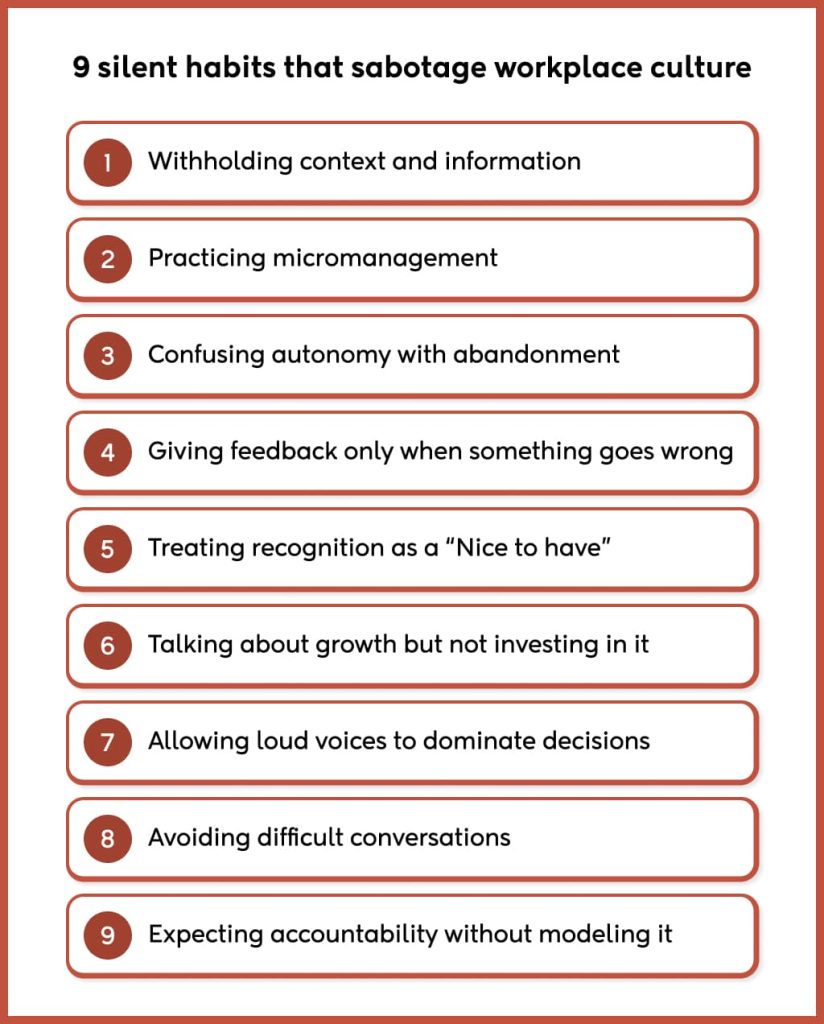
1. Withholding context and information
When managers share decisions without explaining the reasoning behind them, teams are left to fill in the gaps themselves. And they always do it through assumptions, side conversations, and rumors. Even when intentions are good (“they don’t need all the details”), this kind of opacity quietly reduces trust. People disengage not because they disagree, but because they feel excluded. When people don’t understand the why, they can’t connect their work to a larger purpose. Over time, work starts to feel transactional instead of a meaningful contribution.
Managers often withhold context for what they think are good reasons: to avoid overwhelming people with unnecessary details, to maintain confidentiality around sensitive matters, or because they’re moving fast and don’t have time to explain.
How to improve
- Share context early and often. Don’t wait for confusion or resistance to appear. Instead, explain what’s happening while decisions are still forming, not after they’re finalized.
- Explain the reasoning, not just the outcomes. Briefly share the constraints, trade-offs, or goals that shaped the decision—what changed, what stayed the same, and why.
- Connect decisions to the team’s work. Convey how this decision affects priorities, expectations, or impact, so people can see where their work fits into the bigger picture.
2. Practicing micromanagement
When managers say they trust their team but still over-check every task, demand constant updates, or insist work be done their way, the message is loud and clear: I don’t actually trust you. This contradiction damages ownership silently, and people stop thinking independently, stop taking initiative, and start doing just enough to get approval. What looks like “quality control” slowly turns into dependency and disengagement.
Managers micromanage due to work pressure, fear of mistakes, or past experiences where things went wrong. Checking in feels like being responsible. Over time, this habit becomes automatic, especially when managers are accountable for outcomes but don’t fully trust the process.
How to improve
- Define the outcome, be clear about the quality, deadline, success criteria, and the deadline.
- Replace constant check-ins with agreed milestones. Align upfront on when updates are required so progress is visible without interrupting the flow.
- Interfere only when standards aren’t met. If the work meets expectations, resist the urge to redo or tweak.
Read more: Explore the things that need to be common in managers and what you can do to create high-performing teams.
3. Confusing autonomy with abandonment
Autonomy doesn’t mean disappearing. When managers hand over responsibility without clarity on priorities, success criteria, or support, employees don’t feel empowered; they feel exposed. The silence feels like neglect. Over time, people stop taking initiative, not because they lack capability, but because they’re unsure what “right” even looks like.
Managers often equate autonomy with staying hands-off, especially with experienced teams or in remote setups. In trying not to micromanage, they swing too far in the opposite direction, mistaking absence for empowerment.
How to improve
- Clarify priorities and decision boundaries. Be explicit about what matters most, where people can decide independently, and where alignment or approval is needed.
- Define success criteria, non-negotiations where people aren’t guessing what right looks like. Schedule short, predictable check-ins to support. This will keep them focused on removing obstacles.
4. Giving feedback only when something goes wrong
When feedback only appears as correction, people begin to associate visibility with risk. Good work goes unnoticed, effort feels invisible, and teams start playing it safe. This kind of culture doesn’t push performance; it breeds fear, defensiveness, and quiet disengagement.
Many managers assume good work doesn’t need feedback. If someone did their job well, they already know it. Some worry that praising someone might make them complacent or reduce their motivation to improve. As a result, feedback becomes reactive, focused on fixing problems rather than reinforcing what’s working.
How to improve
- Acknowledge good judgment, effort, and progress in real-time
- Balance corrective feedback with reinforcement. When something needs fixing, also name what was done well to keep feedback developmental, not discouraging
- Make feedback a regular habit, not a reaction. Small, consistent signals matter more than occasional, high-stakes conversations.
Read more: Master the art of feedback to build better relationships with your team members.
5. Treating recognition as a “Nice to have”
When recognition is inconsistent or delayed, motivation quietly leaks out. High performers feel especially overlooked, not because they want praise, but because effort without acknowledgement starts to feel like exploitation. Over time, people stop going the extra mile and settle into doing what’s required.
Recognition often slips when workloads increase. Managers assume compensation, promotions, or personal motivation are enough. Over time, appreciation gets postponed until “there’s time”, which rarely comes.
How to improve
- Be specific about what worked and why it mattered, so people know what to repeat.
- Normalize feedback outside of mistakes. Make observation and acknowledgement part of everyday work, not just course correction. Use feedback to reinforce patterns, not just fix errors. The behaviors you notice and name are the ones teams will keep practicing.
- Call out contributions that protect quality, support teammates, or prevent problems.
6. Talking about growth but not investing in it
Saying “we support growth” without providing coaching, learning opportunities, or meaningful stretch work sends a clear message: development is optional. Employees don’t lose ambition; they lose faith. When growth feels like a promise with no follow-through, top talent starts looking elsewhere.
For managers, supporting growth sounds important, but delivery pressure, limited budgets, and tight timelines push development to the background. Growth becomes a conversation rather than a commitment embedded in daily work.
How to improve
- Assign stretch responsibilities. Give team members work that expands their skills with support, not tasks that simply add load.
- Offer regular coaching. Use real work moments to guide, reflect, and course correct, not just formal reviews.
- Create a protected space for learning. Make development part of planning and priorities, not something people do when time allows.
7. Allowing loud voices to dominate decisions
When the same few voices shape every decision, silence spreads across the room. Quieter, newer, or diverse perspectives slowly disengage, not because they lack ideas, but because they learn their input doesn’t matter. Exclusion becomes the norm, even without bad intent.
Managers often mistake confidence, speed, or assertiveness for competence. In fast-moving discussions, it’s easier to rely on the most vocal contributors than to slow down and invite broader input.
How to improve
- Design inclusion into discussions. Structure meeting with rounds, prompts so input doesn’t depend on who speaks first.
- Create space for written or async feedback. Use docs, chats, or pre-reads to capture ideas from people who think better outside of live debate.
- Reward thoughtful contributions. Acknowledge insight, preparation, and impact—so influence isn’t tied to airtime.
8. Avoiding difficult conversations
When managers avoid addressing poor behaviour, low performance, or unresolved conflict, silence does the talking. Teams quickly learn what’s tolerated, and it’s rarely what’s written in the values deck. This results in resentment, slippage of standards, and a feeling of punishment for those who care more than others.
Difficult conversations are uncomfortable. Managers worry about damaging relationships, triggering conflict, or saying the wrong thing. Avoidance feels kinder in the moment, even though it creates bigger problems later.
How to improve
- Address issues early and directly. Don’t wait for patterns to harden or frustration to spill over.
- Be direct, factual, and respectful. Focus on observable behaviour and impact, not assumptions or intent.
- Frame the conversation around standards and support. Make it clear that the goal is alignment and improvement, not blame.
9. Expecting accountability without modeling it
Nothing undermines credibility faster than leaders who demand accountability but dodge it themselves. Blaming downward, avoiding ownership, or making exceptions quietly signals that rules are flexible for some. Trust wears away not through one big failure, but through repeated inconsistencies.
Managers feel pressure to appear confident and decisive. Admitting mistakes can feel risky, especially in high-stakes environments. Over time, accountability gets framed as something expected from others, not practiced personally.
How to improve
- Model the behavior you expect. Hold yourself to the same standards you set for the team, especially when it’s uncomfortable.
- Own mistakes publicly. Acknowledge what went wrong, your role in it, and what you’ll do differently next time.
- Show accountability before asking for it from others. When people see ownership in action, accountability becomes cultural, not enforced.
Read more: Moreover, you can explore how managers can identify early signs of burnout in their team members and take action.
Conclusion
Workplace culture isn’t built overnight; it’s shaped every day by small leadership behaviors that often go unnoticed. When managers ignore these habits, trust fades, motivation drops, and engagement suffers. The good news is that these habits can be corrected with awareness and intent. By being more transparent, supportive, inclusive, and accountable, managers can create an environment where people feel valued and confident in their work. Strong cultures don’t need perfection; they need consistency, clarity, and leaders who are willing to improve.





























































No Comments