
Every new year, advice posts follow a script. Work harder. Optimize your morning. Find your ikigai. It’s the same recycled wisdom that sounded good last year and will sound good next year, and almost none of it changes how people actually work.
People are working plenty. The problem is that work itself has become structurally broken. Microsoft’s 2025 Work Trend Index found that the average employee gets 117 emails per day, 153 Teams messages every weekday, and an interruption every two minutes. Half of all workers say their days feel chaotic and fragmented. Surprisingly, half of managers worldwide have never received any training in managing people. So you’ve got undertrained leaders trying to coordinate overtired teams while notifications explode across every device.
Motivation won’t fix this. You can’t productivity-hack your way out of structural chaos. What you need are constraints—simple rules that prevent work from expanding infinitely and close loops instead of opening endless tabs in your brain. Each rule mentioned below targets a specific failure pattern: work that never closes, effort that hides behind activity, priorities that don’t actually prioritize, emotional weight that compounds silently, learning that evaporates, and systems that collapse under normal conditions. So here are the six rules that are practical corrections.
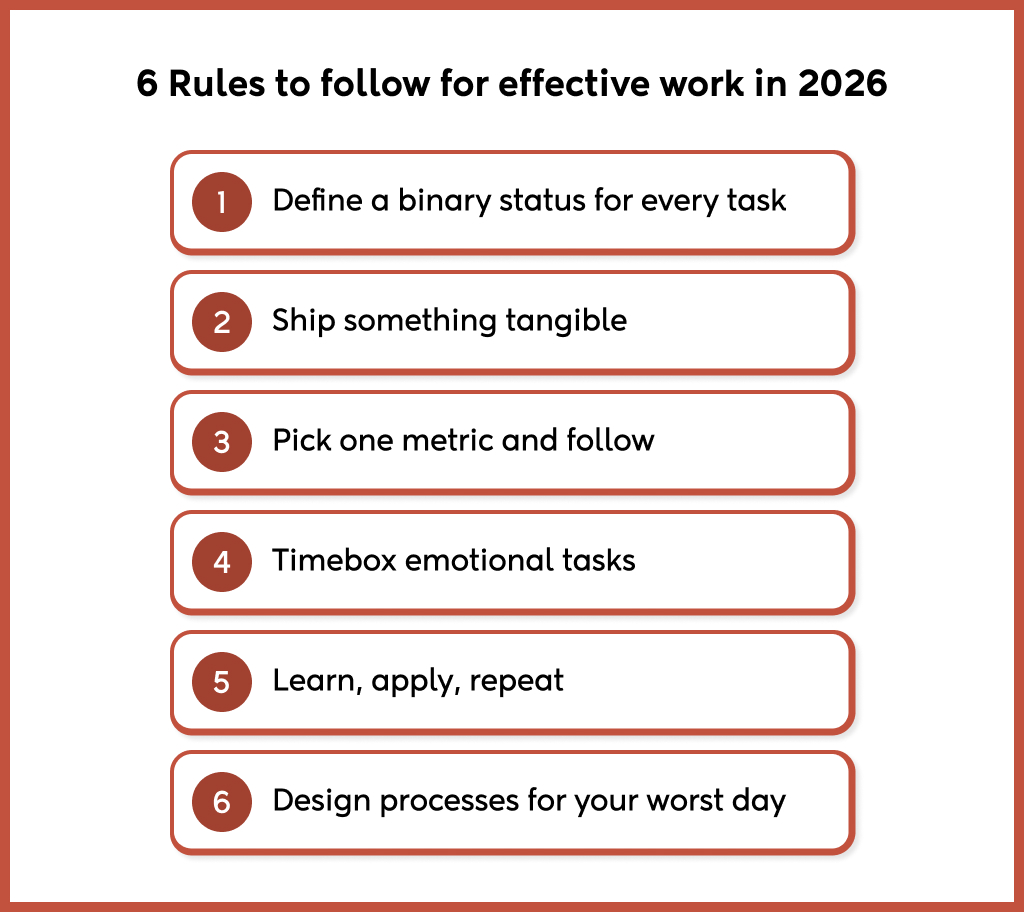
1. Define a binary status for every task
Here’s what happens without fixed deadlines: projects “evolve,” emails generate more emails, dashboards refresh, and tasks stay open indefinitely. Your brain keeps running background processes for all of it. That’s why you’re tired even when you’re not working.
Fix: Make everything binary. Either it’s done, or it’s not.
- “Email the proposal to Jordan by 3 p.m.” Done or not done.
- “Get legal approval on the contract.” Approved or not approved.
- “Pick between Agency X and Agency Y by Thursday.” Decision made or not made.
Cross the line, close the loop, move on. If something takes a month, break it into weekly pieces, each with its own finish line. Your brain will thank you.
2. Ship something tangible
Have you noticed what people gravitate toward when they’re nervous about their work? Meetings. Lots of them. Meetings feel safe because responsibility diffuses. If fifteen people are in the room and something goes wrong, nobody’s individually on the hook. A document with your name on it is different. Someone can point at it and say “this is weak” or “this doesn’t make sense.” That’s exposure.”
So people stay busy instead. They join calls, respond to messages, and appear active on Slack. But busyness becomes protective camouflage for the core issue. You’re visibly working, so nobody questions your contribution.
Fix: Force yourself to ship things people can evaluate. Write the vendor comparison and send it. Draft the one-pager from user research and post it. Build the metrics dashboard and share the link. Put your name on something.
Attending five meetings about the pricing strategy isn’t the same as writing down what the pricing should be and why. Taking notes in three brainstorming sessions isn’t the same as proposing which idea to build first.
3. Pick one metric and follow
Most people’s to-do lists are infinite. Every Slack message feels urgent. Every meeting invitation gets accepted. You react to whoever yells loudest, and by Friday, you can’t remember what you actually accomplished.
The issue isn’t time management. You’re treating all work as equally important, which means nothing is actually important. You need a hierarchy. Without a dominant metric, your energy just scatters across work that doesn’t matter. You stay busy, you feel productive, and nothing actually moves forward.
Fix: Pick one metric that will run your schedule. Maybe two if you’re ambitious, but start with one. It should tie directly to an outcome that matters: revenue growth, conversion rates, project completion, and customer retention.
- “Get trial-to-paid conversion above 12% this quarter.”
- “Publish three bottom-of-funnel pieces this month.”
- “Cut the average deal cycle time by 15 days.”
When someone asks for your time, check it against the metric. If the request doesn’t move that number, you delay it, delegate it or say no. People won’t like hearing no. They’ll push back. Some will get annoyed. Do it anyway.
Read more: How To Improve Your Delegation Skills: Practical Steps For Managers
4. Timebox emotional tasks
Sometimes work isn’t just about completing tasks. It’s relationships, conflicts, and narratives running in your head. The argument you had with your coworker on Tuesday. Anxiety about whether the client will renew. Tension at home. Your kid’s school situation.
These don’t pause while you work. They run in the background, consuming working memory. This is why you can stare at a document for twenty minutes and not retain a single sentence. Your brain is processing something else.
You can’t really suppress emotions. Instead, give them a container—specific times and places where you deliberately process them, rather than letting them leak into every hour.
Fix: Journal for ten minutes before you start deep work and dump everything bothering you onto the page. Block thirty minutes after lunch to work through whatever stressful conversations happened in the morning. Decide that after 7 p.m., work messages stay unanswered unless something is literally on fire.
If a conflict needs resolution—a difficult conversation or a disagreement with a colleague—schedule it rather than letting it fester. Unresolved tension doesn’t fade over time. It compounds. It runs constantly in the background, draining the cognitive capacity you need for actual work.
5. Learn, apply, repeat
A lot of professionals love learning. Courses, books, frameworks, podcasts—they consume them constantly. Learning feels productive and safe because there’s no risk of failure. Nobody can criticize you for reading a book.
But knowledge that isn’t applied decays quickly. The half-life is measured in days, not months. You complete a course in data analysis and feel a sense of accomplishment. Two weeks later, you’ve forgotten most of it. A month later, it’s gone.
Unapplied learning is just expensive procrastination. It feels virtuous, which makes it more dangerous than regular procrastination.
Fix: Tie everything you learn to something you must build within a week. Read about a new analytics approach? Run it on your team’s data tomorrow. Watch a talk about pricing strategy? Test one idea on your following proposal. Take a course on writing? Apply the technique to the email you send on Friday.
You’re not trying to accumulate knowledge. You’re trying to convert information into skill, and that only happens through application. When you apply something, you get feedback. You discover what works, what doesn’t, and where your understanding has gaps. Without that forcing function, learning becomes entertainment.
6. Design processes for your worst day
This is the most important rule. Most plans, frameworks, and methods assume perfect conditions. Full energy, empty inbox, clear calendar, no surprises. Then reality arrives. You get sick. Your calendar explodes with urgent meetings. A team member quits—a project derails. A family emergency happens.
If your system only works under ideal conditions, you don’t have a system. You have a wish.
Fix: Pressure-test your system on your worst days. Commit to publishing twice a month? Block six writing sessions in your calendar, not two. If one session is destroyed, you still have five. If three are killed, you still have three. Build templates for your recurring reports so that exhaustion doesn’t stop you from shipping. Keep checklists for standard tasks—publishing a post, prepping for a client call—so you don’t rely on memory when your brain is foggy.
This is how you avoid the boom-and-bust productivity cycle. A big, heroic push for two weeks, then burnout, and nothing ships for a month. That pattern doesn’t work. Consistency does, and consistency comes from systems designed to survive contact with reality.
Conclusion
The numbers paint a grim picture. Workers receive hundreds of messages daily, are constantly interrupted, and operate in sustained chaos. Most managers are improvising because they’ve never been trained. Gallup estimates that effectively engaging the global workforce could add nearly $8.8 trillion to the global economy, representing roughly 9% of global GDP.
That won’t happen through motivational speeches, productivity hacks, or morning routines.
It happens when you force a work item to close instead of leaving it open indefinitely, when you pick what matters and defend it against everything else. When you contain the emotional noise so it doesn’t bleed into every hour. When you convert learning into a skill instead of letting it evaporate. When you build systems that function even when you’re running on fumes.









































No Comments