
Introduction
The middle management squeeze refers to the growing pressure faced by managers positioned between executives and frontline teams. They are expected to deliver results, maintain morale, and adapt to constant change – all while balancing top-down expectations with ground-level realities.
The squeeze grows stronger as organizations demand faster results with fewer resources. Middle managers manage people, reporting, and execution while navigating unclear boundaries and conflicting goals. Every decision requires balance between performance targets and employee well-being, leaving little room for focus or recovery.
The result is exhaustion and disengagement at the very level responsible for keeping organizations aligned. Burnout among middle managers disrupts decision-making, slows execution, and weakens leadership continuity.
In this article, we will discuss what causes the middle management squeeze, its impact on organizations and teams, along with some practical ways to ease the pressure.
What causes the middle management squeeze
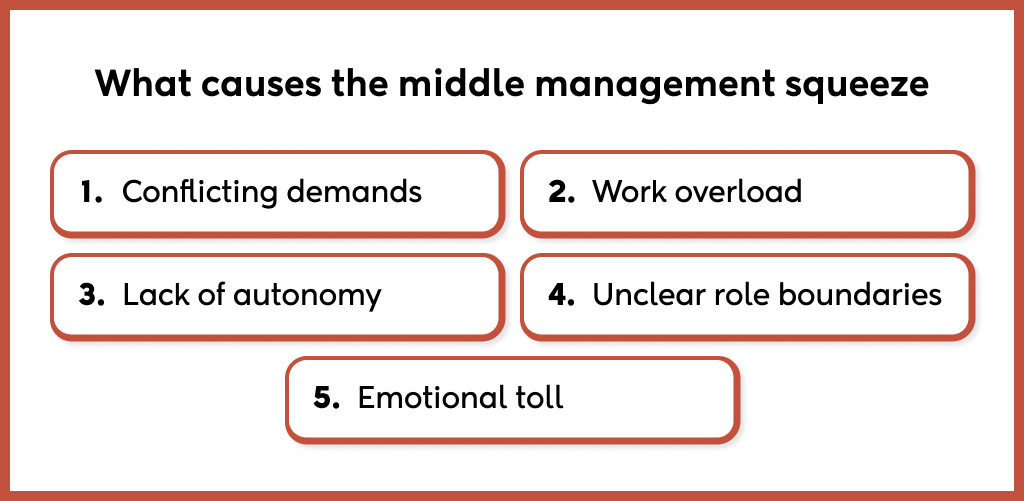
The middle management squeeze happens when managers face competing demands from executives and teams without enough authority, time, or clarity to handle them effectively.
- Conflicting demands
Middle managers execute leadership’s strategic goals while supporting employees’ daily needs. Executives expect efficiency, growth, and compliance. Teams expect empathy, fairness, and development. Balancing both creates constant tension.
- Work overload
Modern organizations push middle managers into administrative, operational, and interpersonal roles at once. Reporting, status updates, performance reviews, meetings, and hiring consume their schedules, leaving little space for strategy or creative problem-solving.
- Lack of autonomy
Despite being accountable for results, middle managers often lack the authority to make meaningful decisions. Approvals flow upward, slowing execution. When decision-making power does not match responsibility, frustration builds.
- Unclear role boundaries
Middle managers frequently operate in undefined spaces – part leader, part executor. They translate vision into action but rarely have clarity on where leadership ends and execution begins. The absence of well-defined scope leads to overlapping responsibilities and competing priorities between departments.
- Emotional toll
Beyond processes and policies, middle managers carry emotional weight. They handle layoffs, manage underperformance, resolve conflicts, and maintain team morale – all while absorbing top-level pressure.
Also read – Key Team Performance Metrics Every Manager Should Track
The impact of middle management squeeze
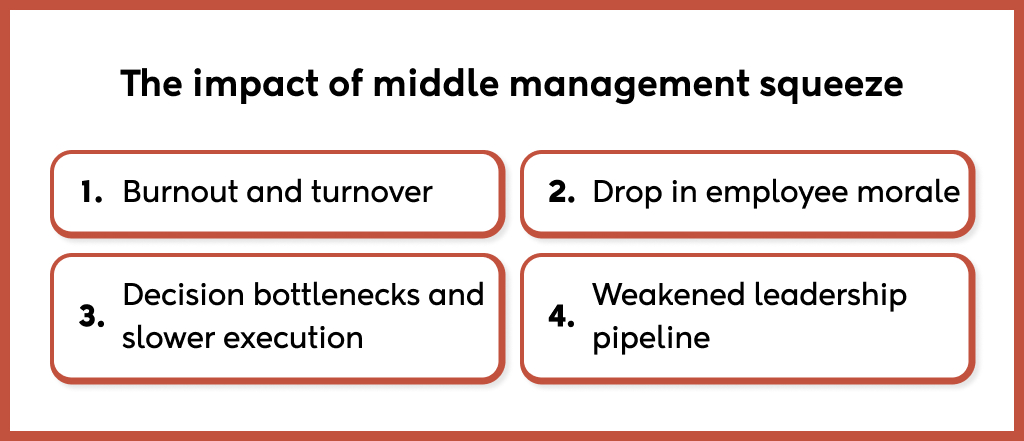
When middle managers operate under continuous strain, the consequences extend beyond individual burnout. The squeeze disrupts team dynamics, decision quality, and overall organizational health.
- Burnout and turnover
Prolonged pressure leads to fatigue and emotional exhaustion. Burned-out managers lose motivation, empathy, and clarity in decision-making, leading to attrition. Replacing an experienced manager costs far more than retaining one – both in productivity and institutional knowledge.
- Drop in employee morale
Teams mirror their manager’s emotional state. When managers operate in survival mode, communication becomes transactional. Employees sense detachment, leading to lower trust and weaker collaboration. Over time, this creates quiet quitting and reduced discretionary effort.
- Decision bottlenecks and slower execution
When middle managers need to escalate every decision upward, it slows everything down. Projects get stuck in endless approval loops, and innovation drops as managers avoid taking risks. This constant squeeze reduces agility – a critical disadvantage for fast-moving industries.
- Weakened leadership pipeline
Constant stress discourages employees from aspiring to management roles. They see leadership as a burden. Over time, organizations face a leadership gap – fewer qualified successors and increased dependence on external hires. This weakens continuity and culture alignment.
Also read – Finding Your Team’s Productivity Sweet Spot: Avoiding Burnout and Boredom
How to ease the pressure for your middle managers
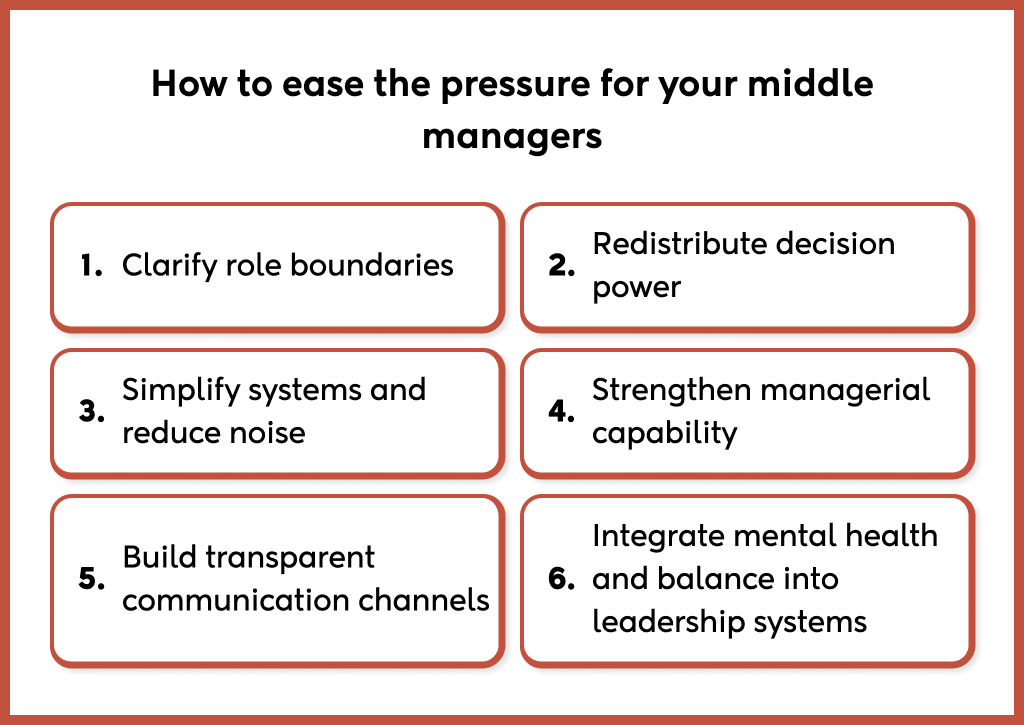
Middle management pressure reduces when organizations remove structural barriers, define clear boundaries, and strengthen decision autonomy.
- Clarify role boundaries
Clearly define where leadership responsibilities end and operational tasks begin. When expectations are documented and communicated, managers gain clarity on priorities, performance goals, and where their focus should lie. This clarity helps them lead with confidence rather than constantly switching between blurred roles.
- Redistribute decision power
Empowering managers to make tactical and team-level decisions can reduce that stress. When leaders trust their managers with real authority and support those decisions publicly, it builds ownership, confidence, and faster problem-solving. Autonomy is the foundation of effective leadership in the middle layer.
- Simplify systems and reduce noise
Simplify workflows to lighten their cognitive load. Replace redundant reports with transparent dashboards. Consolidate communication and task tracking in a digital platform like ProofHub to centralize updates, files, and deadlines so managers don’t waste hours switching between systems. When the noise reduces, managers can focus on outcomes instead of process maintenance.
- Strengthen managerial capability
Middle managers need coaching that strengthens emotional intelligence, communication, and decision-making under pressure. Leadership development programs focus on real-world challenges like managing team morale during uncertainty, handling conflict, or giving constructive feedback. When organizations invest in these areas, managers become more resilient and better equipped to handle the emotional and strategic demands of their role.
- Build transparent communication channels
A lot of middle management stress stems from unclear expectations and lack of honest dialogue with senior leaders. Encourage open, two-way communication where managers can share ground realities without fear of judgment. Replace top-down directives with regular alignment conversations that clarify priorities and remove confusion.
- Integrate mental health and balance into leadership systems
Encourage managers to take time off, set boundaries, and avoid glorifying overwork. Normalize mental health conversations and provide access to counseling or coaching support when needed. Recognize their efforts regularly, not just their outcomes. When managers are seen, supported, and balanced, they lead with more empathy and energy, which reflects in team engagement and performance.
How managers themselves can cope
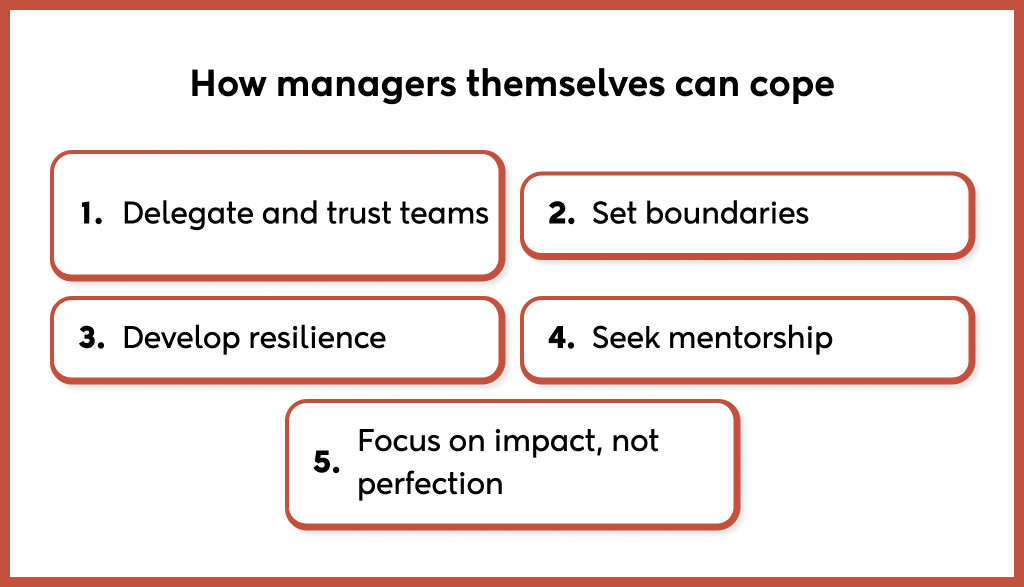
Middle managers can ease their own pressure by practicing self-leadership. Managing energy, focus, and emotional control is as critical as managing people.
- Delegate and trust teams
Delegation is the most effective way to create space for leadership work. Managers who try to solve every problem become bottlenecks. Assign responsibility with clear outcomes and trust teams to deliver.
Delegating builds ownership, strengthens accountability, and frees time for strategic priorities. When managers stop micromanaging, performance and confidence rise on both sides.
- Set boundaries
Boundaries preserve focus and energy. Limiting after-hours availability and saying no to non-essential requests prevent exhaustion. Managers should define their core hours and communicate them clearly.
Protecting personal time ensures consistent performance during work hours. When boundaries are respected, work becomes sustainable, not draining.
- Develop resilience
Resilience allows managers to absorb stress without losing clarity. Mindfulness, physical exercise, and short reflection routines strengthen emotional control.
Regular pauses between tasks or meetings help reset mental energy. A resilient manager reacts less and leads more. The ability to recover quickly turns pressure into progress.
Also read – Why emotional intelligence is important for managers
- Seek mentorship and peer support
Mentorship offers perspective while peer support provides relief. Connecting with other managers helps share coping methods and practical advice. Conversations with peers reveal that challenges are common, not personal.
Mentors guide decision-making through experience, while peers provide empathy and shared problem-solving. Support networks turn isolation into insight.
- Focus on impact, not perfection
Perfection delays progress and leads to burnout. Managers should prioritize outcomes that deliver visible results. Communicate capacity limits clearly and align tasks with organizational impact.
Progress measured by results, not flawless execution, builds credibility and control. Leading for impact helps managers focus energy where it matters most.
Conclusion
Middle managers hold organizations together. Yet, they operate under the highest pressure with the least recognition. Easing that squeeze is an act of relief as well as a business necessity.
Sustaining middle management health ensures more productivity and builds stability, faster decisions, and stronger teams. Supporting the middle is supporting the organization’s core.



























































No Comments