
As a manager, you’ve likely been conditioned to believe that your job is to minimize risk, catch every flaw, and deliver flawless results.
But this mindset is backfiring.
Teams become overly cautious due to endless review cycles, multiple approval layers, and waiting for complete data before making decisions. As a result, your team has stopped proposing innovative ideas. When they consider contributing, they tend to second-guess creative solutions.
As a result, progress halted while competitors moved faster.
The irony is that to avoid small mistakes, you make the biggest mistake of all: doing nothing while the market moves on without you.
The most innovative companies don’t succeed because they’re perfect. They succeed because they learn from imperfect attempts and adapt faster than everyone else. Embracing imperfection isn’t about lowering standards; it’s about unlocking the innovation your team has been holding back.
This article proposes different practical steps with which managers can embrace imperfection for innovation.
5 ways in which managers can embrace imperfection for innovation
As a manager, your job is not to deliver tasks on time, but to drive innovation within your organization. By embracing imperfection, you can create a supportive environment where continuous progress and growth are encouraged.
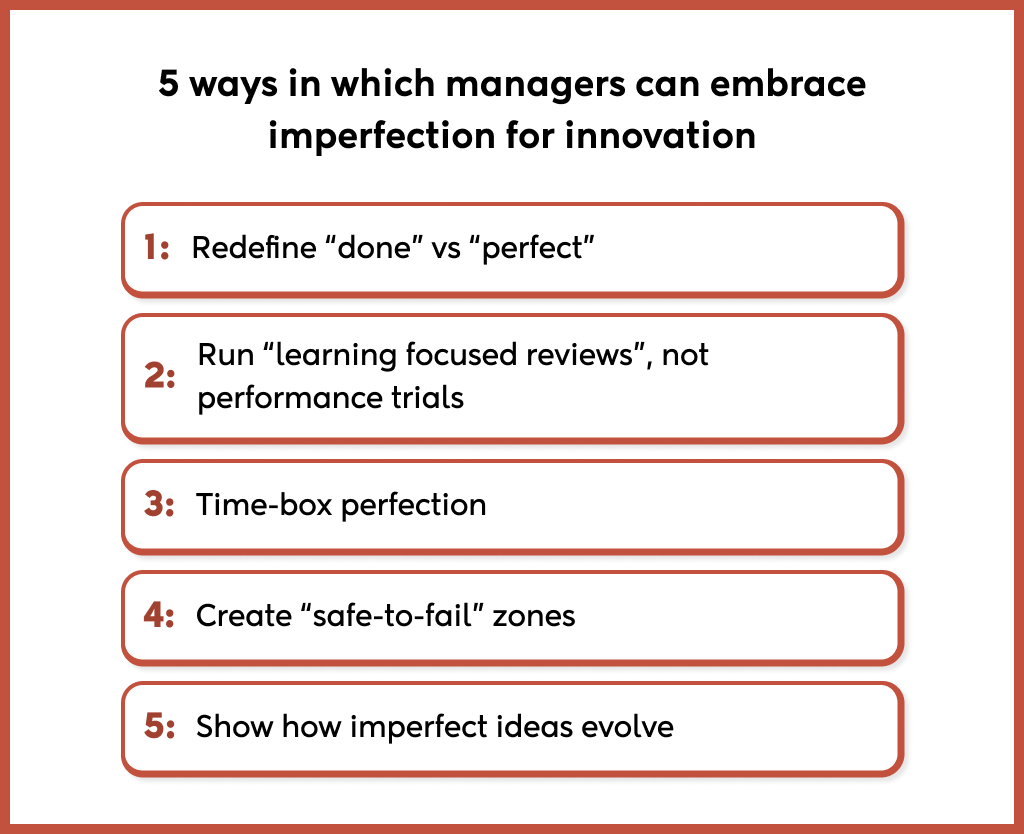
The following are some practical ways in which you can embrace imperfection for innovation-
1. Redefine “done” vs “perfect”
The shift:
Label work as “version 1” explicitly. Set tight deadlines that prevent perfection. In reviews, spend 80% discussing what’s working, 20% on fixes. Celebrate rough drafts by thanking people for speed. Make it clear: version 1 is a starting point for conversation, not a finished product.
How it sparks innovation:
When teams don’t need all answers before starting, they actually start. Early versions reach users faster, providing feedback while the work is still changed. This speed creates momentum and confidence, and the fear vanishes as experimentation feels safe and expected.
What to say to your team:
“I’d rather see a usable first version today than a perfect one next month.”
2, Run “learning focused reviews”, not performance trials
How to practice it:
After every project, whether it is successful or not, hold a retrospective with one purpose: learning. Structure the conversation around three questions: What worked? What didn’t? What will we try differently next time? Set clear ground rules and focus only on processes and systems.
The shift:
When people know they won’t be blamed, they tell the truth. That honest insight reveals the real bottlenecks and the unexpected discoveries that could become your next breakthrough. Through this, each project becomes a learning opportunity that makes the next one better. Psychological safety grows with every blameless review, and as safety increases, so does your team’s willingness to take creative risks and propose unconventional ideas.
What to say to your team:
“This isn’t about who made mistakes, it’s about what we learned as a team.
3. Time-box perfection
How to Practice It:
Set clear and non-negotiable time limits for initial work and communicate them upfront: “You have 48 hours to draft this” or “I need your first take by the end of day Thursday.” Make it explicit that refinement comes after feedback, not before submission. Use these boundaries consistently so your team learns to work within them.
How it sparks innovation:
When your team can’t overthink every detail, they focus on what truly matters and find surprisingly innovative solutions under pressure. The deadline forces decisions, cuts through analysis paralysis, and prevents the endless changes that kill momentum. Teams discover they’re more resourceful than they thought, finding creative shortcuts and innovative approaches they’d never consider with unlimited time.
What to say to your team:
“You have 48 hours to draft this, focus on getting the core idea down, and we’ll refine it after feedback.”
4. Create “safe-to-fail” zones
How to practice it:
Designate specific projects explicitly as experimentation zones where trying new approaches is the goal. Label them clearly. Communicate upfront that these initiatives won’t affect performance reviews or team evaluations; they exist purely to explore what’s possible. This is especially important for teams struggling with failure and hesitant to take risks. Set boundaries around scope, time, and resources so experiments stay contained, then give your team genuine freedom within those boundaries to try unconventional methods, tools, or strategies they’ve been curious about.
How it sparks innovation:
Innovation becomes intentional when there is room for experimentation. Your team feels liberated to test different ideas they’ve been sitting on, try the unconventional approach they thought was “too risky,” or challenge assumptions about how work should be done. The best ideas often emerge from these experiments, and even the “failures” reveal valuable insights about what doesn’t work, saving you from bigger mistakes down the line.
What to say to your team:
“We’re designating this project as an experimentation zone, try approaches you’ve been curious about, even if they’re unconventional. This is about learning what’s possible, not delivering perfection.”
5. Show how imperfect ideas evolve
How to practice it:
Make the evolution of ideas visible to your entire team. When a project succeeds, don’t just celebrate the final result; tell the story of how it started rough and improved through iteration. In team meetings or internal communications, highlight specific examples of rough drafts that became strong outcomes, giving credit to both the original idea-bringer and those who contributed feedback along the way.
How it sparks innovation:
When people see that successful outcomes started in chaos, imperfection stops feeling like failure and starts feeling like progress. Your team internalizes that the rough draft is a necessary and valuable stage, not something to be embarrassed about. This transparency builds collective confidence if that great project started imperfectly, then my imperfect idea has potential too. People become more willing to share early-stage thinking because they understand iteration is how excellence happens, not a detour around it.
What to say to your team:
“Let me show you how this successful project actually started; version 1 was rough, but it gave us something to build on.” Point out the journey: “The initial idea was barely formed, but because the team shared it early, we got feedback that shaped it into what you see now.”
Read more: Meanwhile, learn how to build trust in your team to motivate your team and drive organizational success.
Challenges managers face when they embrace imperfection for innovation
Several challenges faced by managers when they embrace imperfection are mentioned below-
- Manager’s own perfectionist tendencies
- Team members confusing imperfection with low standards
- Pressure to deliver flawless results under tight deadlines
- Residual fear from past blame-driven work cultures
- Balancing accountability without reintroducing fear
- Uneven comfort levels with risk and experimentation
- Pushback from leadership or stakeholders expecting certainty
- Difficulty measuring learning, experimentation, and progress
Read more: A leader must be good at delagtion while embracing imperfection. Learn how to improve your delegation skills through this article.
Conclusion
To put it all together, embracing imperfection is about choosing progress over paralysis. The managers who want to drive innovation in their organization create environments where experimentation is safe, iteration is expected, and learning happens fast.
The shift won’t be easy. You need to start small: pick one approach, whether redefining “done” or creating a safe-to-fail zone. Give your team permission to be imperfect. In a fast-moving world, competitive advantage goes to those who learn quickly and adapt constantly, not those who plan perfectly.




























































No Comments